








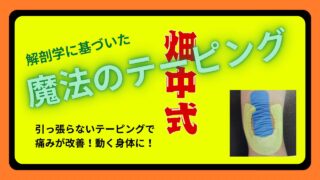
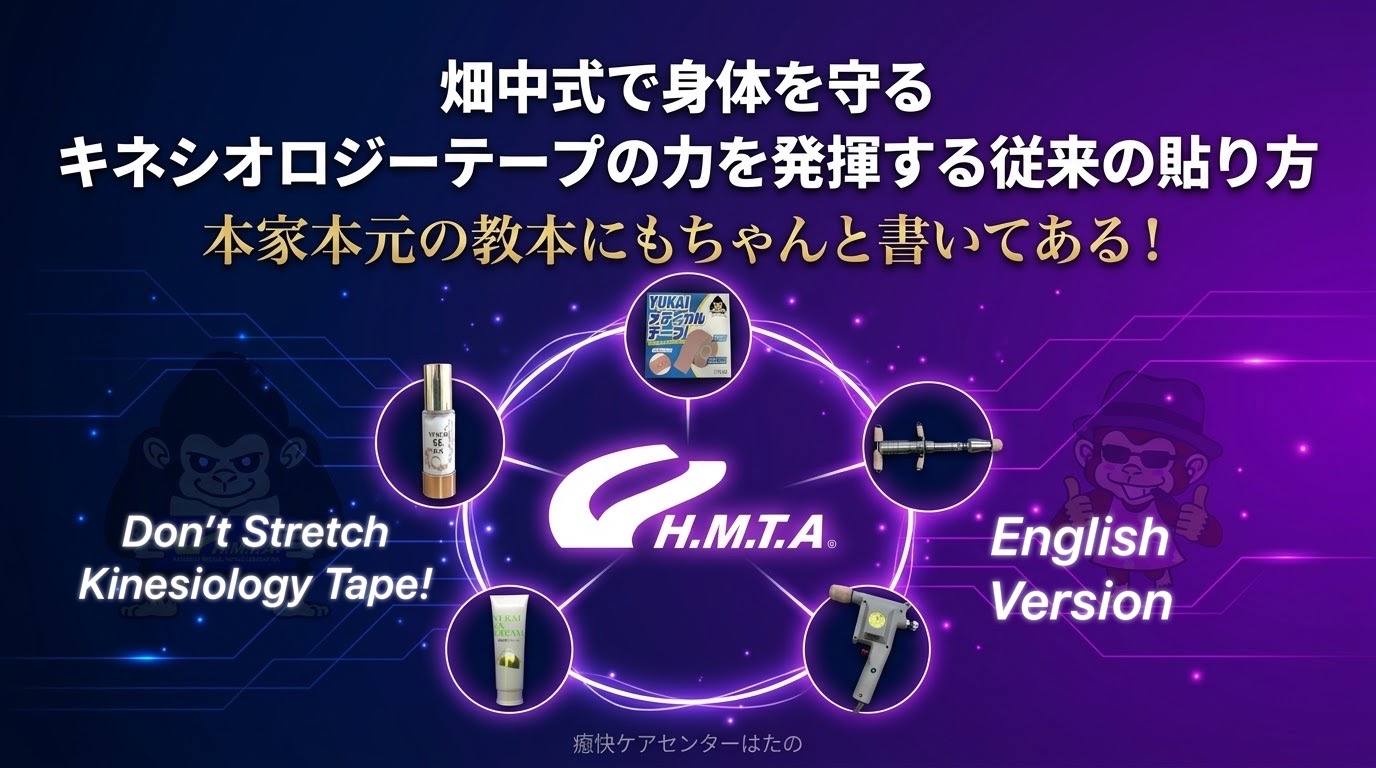
The Original Textbook Says, “Don’t Stretch the Tape”… So Why Do So Many Practitioners Still Apply Kinesiology Tape Under Tension?
【Don’t Stretch Kinesiology Tape!】
The Proper Method Taught in the Original Textbook—and Why Stretching the Tape Can Harm Muscles
“Just pull the tape tight and secure it because it hurts.”
“In sports settings, tape should be applied tightly to support the muscles.”
Do you apply kinesiology tape this way?
If so, you may be surprised to learn that, according to the original textbook on kinesiology taping, this is actually a major mistake.
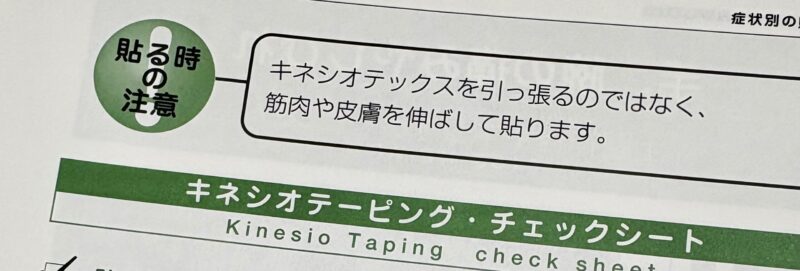
The foundational textbook clearly states:
“Do not stretch the tape. Instead, stretch the muscle or skin and apply the tape in that position.”
And this principle appears throughout the textbook.‼️
Just how important was this fundamental concept to the founder of kinesiology taping therapy, Kenzo Kase, D.C.?
Yet when we look at how kinesiology tape is commonly applied today, we see tape being stretched and pulled in almost every case. 😭
Why Shouldn’t You Stretch the Tape?
When tape is pulled tightly and applied to the skin, the skin and fascia remain under constant tension.
At first glance, this may give the impression that the body is being “firmly supported.”
But that is precisely where the problem lies.
When the skin and muscles are continuously subjected to unnatural tension, the body may respond by becoming even more tense and stiff.
Imagine wearing a pair of jeans that are far too tight. When you sit down or try to lift your legs, your movements become restricted and uncomfortable.
The same principle applies here.
As a result:
- Muscle movement can become restricted.
- Blood and lymphatic circulation can be impaired.
- In the worst-case scenario, excessive tension may contribute to muscle damage.
In other words, taping that is supposed to support the body may end up becoming a source of additional stress and discomfort.
Where Did Kinesiology Tape and Kinesiology Taping Therapy Come From?
A “No-Stretch” Tape Born from a Mistake
There is an important story behind the development of kinesiology taping.
At one point, its developer, Kenzo Kase, D.C., applied the rigid white athletic tape commonly used in sports to a patient suffering from joint pain.
That very day, however, the patient’s swelling and pain became worse.
This experience led Kase to an important realization:
“Joints are moved by muscles. When muscles are forcibly stretched, they can actually contract and tighten, causing the joint to become misaligned.”
From there, he began thinking:
“If there were a specialized elastic tape that could prevent muscles from being overstretched, perhaps we could restore normal muscle movement without compressing the joint.”
That idea became the starting point for the development of kinesiology taping.
Why Does the Pain Seem to “Melt Away”?
Understanding the Mechanism of Pain
When muscles become inflamed or stiff from fatigue, the space between the muscles and the skin becomes narrower.
As a result, the circulation of lymphatic fluid and other fluids can become impaired.
When this happens, sensory receptors responsible for detecting pain can become stimulated, causing us to experience pain.
This is one of the mechanisms through which pain can arise.
The “Miraculous 10 Microns”
The “Miraculous 10 Microns” Created by the Tape
Here is one of the most important points when applying elastic kinesiology tape:
Stretch the skin or muscle, but do not stretch the tape itself.
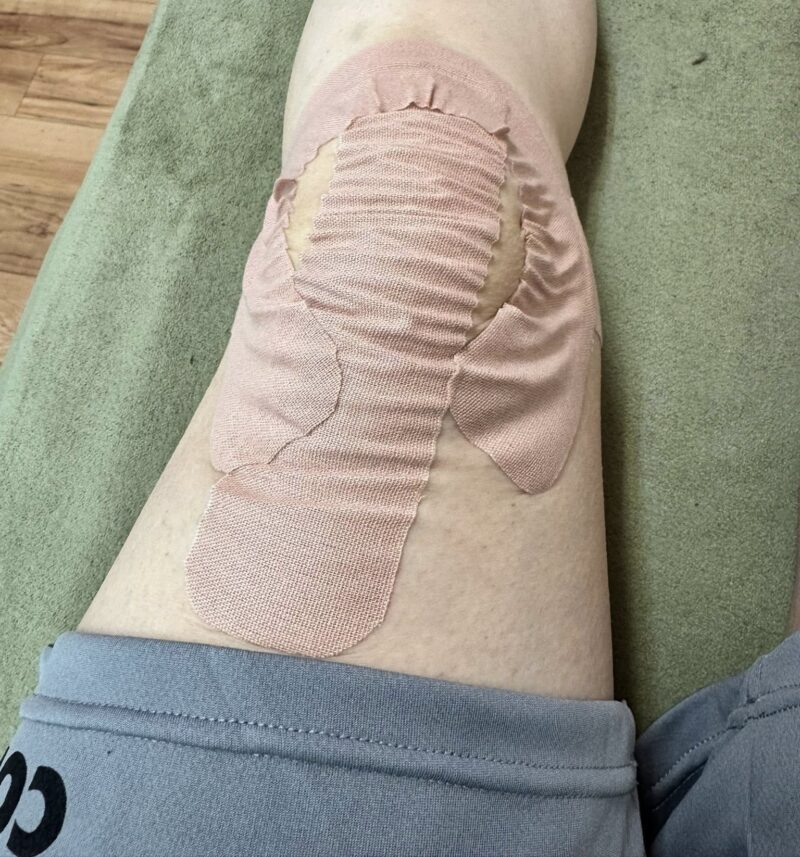
After the tape has been applied and the skin returns to its normal position, fine wrinkles form on the surface of the skin.
These wrinkles are evidence that the tape is gently lifting the skin and underlying tissues.
As a result, a tiny space—just 10 microns, roughly equivalent to the thickness of one or two sheets of plastic wrap—is created beneath the skin.
This can help:
- Allow lymphatic fluid to flow more freely.
- Reduce friction between muscles and tissues that have been rubbing against one another.
- Reduce stimulation of pain receptors.
- Allow the body’s natural healing mechanisms to function more effectively.
In this way, the principles of kinesiology—the study of human movement—and the effects of elastic therapeutic taping came together, leading to the development of kinesiology taping therapy.
Why Do So Many Practitioners Still Apply the Tape Under Tension?
So why do so many practitioners and trainers continue to stretch the tape when applying it?
The reasons are actually quite simple.
“Because it feels like it’s working.”
“Because the tape is easier to handle and looks cleaner when stretched.”
“Because they do not fully understand anatomy and functional movement.”
There is also a psychological factor on the patient’s side.
When someone is tightly taped or firmly immobilized, they may feel:
“I’m really being treated!”
or
“It feels safer because everything is firmly secured.”
However, professionals who truly understand the structure of the human body—anatomy—and the mechanisms of muscular movement recognize the importance of applying kinesiology tape without stretching the tape itself.
The true essence of kinesiology taping lies in using the natural wrinkles created in the skin to help restore circulation and awaken the body’s inherent functions.
Real Care for Your Body
Taping is not simply a means of immobilization.
When used correctly, it can become a powerful ally in supporting the body’s own natural abilities.
If the tape you are currently wearing feels uncomfortable, why not try the “no-stretch application method”?
You may be surprised at how much lighter and more comfortable your body feels.
Carrying on the Original Teachings—and Taking Them Further
My teacher was formerly an instructor with the Kinesio Taping Association.
Today, as the representative of the Yukai Group, he continues to faithfully uphold the teachings of Kenzo Kase, D.C. at the Hatanaka School of Alternative Therapy.
At the same time, he has further developed those principles into his own approach: Hatanaka Medical Taping Therapy.‼️
If you would like to learn more about Hatanaka-style Medical Taping, in which the tape is applied gently and without tension, please feel free to contact us.♪
At Yukai Care Center Hadano, we are committed to using this gentle, “floating” taping technique to support and protect the people who come into our care, as well as the people who are important to them. ❣️
[This was translated by AI.]
この記事は上記noteをAIで英語バージョンにしたものです。表現などに曖昧な部分があるかもしれません。できるだけ日本語で読んでもらいたいです。
This article is an AI-generated English version of the above note. There may be some ambiguities in the expression. I would prefer that you read it in Japanese if possible.


コメント